
Estimating Dynamic Causal Effects with hetiv
Daniel Kaufmann, Marc Burri, Valentin Grob
2026-10-16
Source:vignettes/hetiv-introduction.Rmd
hetiv-introduction.RmdIntroduction
hetiv provides tools for measuring and identifying multi-dimensional structural shocks in dynamic models using two complementary IV approaches:
- Heteroskedasticity-IV (Rigobon 2003, Rigobon and Sack 2004, Lewis 2022, Burri and Kaufmann, 2026b): exploits the higher variance of outcome variables on policy event days relative to control days to identify structural shocks without requiring external instruments.
- Proxy-IV (Mertens and Ravn 2013, Stock and Watson 2018): uses an external instrument (proxy) that is correlated with the shock of interest but uncorrelated with other shocks.
Both approaches are implemented as local projection IV estimators
following Jordà (2005), which directly produce impulse response
functions (IRFs) across multiple horizons. Inference is based on
heteroskedasticity-robust standard errors by default. Montiel Olea et
al. (2025) show that these standard errors suffice for local-projection
impulse responses under weak conditions, even though multi-step forecast
errors are typically serially correlated. Newey-West HAC standard errors
are also available via cov_type = "NW" as an optional
robustness check.
The package allows for multiple shocks and endogenous variables.
Weak-instrument HAR inference is implemented via the generalised minimum
eigenvalue test of Lewis and Mertens (2025), which nests the classical
Stock-Yogo (2005) test for the univariate homoskedastic case.
gweakivtest() is a direct port of the Matlab files by Lewis
and Mertens (2025) available on https://karelmertens.com/research/.
In addition, the package provides kfpredict() for
predicting the underlying unobserved shocks based on the Kalman filter,
as suggested by Burri and Kaufmann (2026a). We currently work on an
extension to exploit multiple IRF horizons for shock extraction.
This vignette demonstrates the functionality using a simulated four-variable VAR with two structural shocks.
Simulated data
We simulate data from a VAR(2) with \(N = 4\) variables, \(E = 2\) event (policy) shocks, \(R = 2\) regular shocks, and \(P = 2\) lags over \(T = 500\) observations. The model reads:
\[y_t = \Psi \varepsilon_t + \Gamma v_t + \Phi(L) y_{t-1} + \beta X_t \ \ \text{for } t\in \mathcal{P}\]
\[y_t = \Gamma v_t + \Phi(L) y_{t-1} + \beta X_t \ \ \text{for } t\in \mathcal{C}\]
where \(\mathcal{P}, \mathcal{C}\) denote policy event and other days, respectively, \(\Psi\) is the impact matrix of \(E\) policy event shocks and \(\Gamma\) the impact matrix of \(R\) other shocks. \(\Phi(L)\) is a conformable lag polynomial, and \(X_t\) is a matrix of deterministic terms.
Regular shocks occur on all days. A policy event occurs every 10th
period (approximately 10% of observations). The latter introduces
heteroskedasticity in the variance-covariance matrix of the reduced-form
residuals hetiv() exploits to identify the impulse response
functions. Shocks are drawn from a standard normal distribution. The
impact matrix is lower-triangular, corresponding to the identifying
assumption by Burri and Kaufmann (2026b) that the first shock has a
contemporaneous effect on all variables, while the second shock has no
contemporaneous effect on the first variable. Deterministic weekday
patterns are added to variables 3 and 4 to illustrate the role of
controls. The event indicator Ind equals 1 on policy event
days and 0 on control days.
library(hetiv)

# Dimensions
N <- 4 # variables
E <- 2 # event shocks
R <- 2 # regular shocks
P <- 2 # VAR lag order
H <- 20 # IRF horizons
Nevn <- 10 # Frequency of event shocks

# Impact matrix for event shocks (N x E); lower triangular for recursive ID
PsiE <- matrix(0, N, E)
PsiE[, 1] <- c(1.0, 0.5, 0.3, 0.2)
PsiE[, 2] <- c(0.0, 1.0, -0.4, 0.3)

SigE <- 4 # event shock variance (scalar, applies to all E shocks)

# Impact matrix for regular shocks (N x R)
PsiR <- matrix(0, N, R)
PsiR[, 1] <- c(1.0, -0.3, 0.2, 0.1)
PsiR[, 2] <- c(0.2, 1.0, -0.1, 0.4)

# VAR coefficient matrices at lags 1 and 2
Phi <- array(0, dim = c(N, N, P))
Phi[, , 1] <- matrix(c(
  0.60, 0.05, -0.04, 0.03,
  0.06, 0.40, 0.05, -0.03,
  -0.05, 0.04, 0.50, 0.06,
  0.03, -0.03, 0.05, 0.70
), N, N, byrow = TRUE)
Phi[, , 2] <- matrix(c(
  0.10, 0.03, -0.02, 0.02,
  0.04, 0.10, 0.03, -0.02,
  -0.03, 0.02, 0.10, 0.03,
  0.02, -0.02, 0.03, 0.10
), N, N, byrow = TRUE)

# Simulate — seed is set internally by simulatedata()
Nobs <- 500
Nbin <- 100
sim <- simulatedata(
  Phi = Phi, SigE = SigE, PsiE = PsiE, PsiR = PsiR,
  Nobs = Nobs, Nbin = Nbin, N = N, R = R, E = E,
  Nevn = Nevn, P = P, eDist = 0, seed = 42
)

# Extract simulated data and event indicator
y_data <- sim$y
Ind <- as.integer(sim$IndE[, 1])

# Add deterministic weekday variation into variables 3 and 4
y_data[, 3] <- y_data[, 3] + 0.5 * seq_len(Nobs) %% 5
y_data[, 4] <- y_data[, 4] + 0.3 * seq_len(Nobs) %% 5
To illustrate the proxy-IV approach, we construct a noisy external
instrument for the two event shocks by adding Gaussian noise to the true
shocks. The proxy is set to zero on control days. This mirrors the
convention of the proxy-SVAR literature (Mertens and Ravn, 2013; Gertler
and Karadi, 2015), where high-frequency surprises are recorded around
policy announcement windows and set to zero otherwise. Setting the proxy
to NA on control days instead excludes those days from the
proxy-IV regressions and reproduces the announcement-day sample of the
event-study literature (Nakamura and Steinsson, 2018). Both conventions
use the same identifying moments, because the first-stage and
reduced-form cross products involve event days only; they differ in the
sample used to estimate the control coefficients. We use zeros as the
default convention.
Estimation
Heteroskedasticity-IV without controls
First, we estimate a misspecified model, failing to control for
lagged dependent variables and weekday-variation. Note that we impose a
normalization on the impact on the endogenous variable for every shock.
The value of the normalization can be chosen by norm. Here,
we choose the normalization that corresponds to the true impact
matrix.
res_het <- hetiv(
  y       = y_data,
  O       = y_data,
  Ind     = Ind,
  P       = 0,
  H       = H,
  E       = E,
  norm    = 1,
  details = TRUE
)
Heteroskedasticity-IV with controls
Second, we estimate the correctly specified model, with \(P = 2\) lags and the weekday dummies. Note that the weekday dummies absorb the deterministic pattern that we added to the data. The regressions generally include a constant term. Therefore, we only add four weekday dummies.
# Weekday dummies: four indicator variables (one left out as reference)
X_data <- matrix(0, nrow = Nobs, ncol = 4)
for (i in 1:4) X_data[, i] <- as.integer((seq_len(Nobs)) %% 5 == (i - 1))

res_het_X <- hetiv(
  y       = y_data,
  O       = y_data,
  X       = X_data,
  Ind     = Ind,
  P       = P,
  H       = H,
  E       = E,
  norm    = 1,
  details = TRUE
)
Proxy-IV
Third, we use the external instrument to estimate the model via
proxy-IV. The same lags are included as in the second model. However,
the weekday dummies are dropped due to collinearity, as only the event
days are used to identify the responses. Note that the proxy-IV function
still requires Ind as an input, because, in case the
instrument is missing, but Ind = 1, we can later on predict
the unobserved shock using the Kalman filter with
kfpredict() (see Burri and Kaufmann, 2026a).
res_proxy <- proxyiv(
  y         = y_data,
  O         = y_data,
  Z         = e_proxy,
  Ind       = Ind,
  P         = P,
  H         = H,
  E         = E,
  norm      = 1,
  recursive = FALSE,
  details   = TRUE
)
Proxy-IV with recursive zero restriction
If the proxies are valid, we do not need additional restrictions to
identify the impulse responses. However, the function allows us to
additionally impose zero restrictions mirroring the assumptions used by
hetiv(). This is useful in a situation where there is some
doubt about the validity of the external instruments, and the researcher
is convinced that a zero restriction is valid.
res_proxy_rec <- proxyiv(
  y         = y_data,
  O         = y_data,
  Z         = e_proxy,
  Ind       = Ind,
  P         = P,
  H         = H,
  E         = E,
  norm      = 1,
  recursive = TRUE,
  details   = TRUE
)
Impact matrices
The estimated impact matrix \(\Psi\) gives the contemporaneous responses of all \(N\) variables to each structural shock. We can compare the estimates across the four specifications against the true \(\Psi\). At first sight, the differences are small. As we will see below, there are still some differences in terms of the accuracy of the estimates, the predicted shocks, and the strength of the instruments.
tab_1 <- round(data.frame(
  True = PsiE[, 1],
  HET_IV = res_het$Psi[, 1],
  HET_IV_X = res_het_X$Psi[, 1],
  Proxy_IV = res_proxy$Psi[, 1],
  Proxy_IV_rec = res_proxy_rec$Psi[, 1]
), 2)

knitr::kable(
  tab_1,
  col.names = c(
    "True", "HET-IV without controls", "HET-IV with controls",
    "Proxy-IV with controls", "Proxy-IV with recursive restriction"
  ),
  caption = paste(
    "Impact matrix estimates ($\\Psi$) for shock 1 across different",
    "specifications"
  )
)| True | HET-IV without controls | HET-IV with controls | Proxy-IV with controls | Proxy-IV with recursive restriction | |
|---|---|---|---|---|---|
| y1.h0 | 1.0 | 1.00 | 1.00 | 1.00 | 1.00 |
| y2.h0 | 0.5 | 0.53 | 0.45 | 0.44 | 0.44 |
| y3.h0 | 0.3 | 0.54 | 0.32 | 0.40 | 0.40 |
| y4.h0 | 0.2 | 0.19 | 0.18 | 0.24 | 0.24 |
tab_2 <- round(data.frame(
  True = PsiE[, 2],
  HET_IV = res_het$Psi[, 2],
  HET_IV_X = res_het_X$Psi[, 2],
  Proxy_IV = res_proxy$Psi[, 2],
  Proxy_IV_rec = res_proxy_rec$Psi[, 2]
), 2)

knitr::kable(
  tab_2,
  col.names = c(
    "True", "HET-IV without controls", "HET-IV with controls",
    "Proxy-IV with controls", "Proxy-IV with recursive restriction"
  ),
  caption = paste(
    "Impact matrix estimates ($\\Psi$) for shock 2 across different",
    "specifications"
  )
)| True | HET-IV without controls | HET-IV with controls | Proxy-IV with controls | Proxy-IV with recursive restriction | |
|---|---|---|---|---|---|
| y1.h0 | 0.0 | 0.00 | 0.00 | -0.06 | 0.00 |
| y2.h0 | 1.0 | 1.00 | 1.00 | 1.00 | 1.00 |
| y3.h0 | -0.4 | -0.46 | -0.31 | -0.51 | -0.48 |
| y4.h0 | 0.3 | 0.27 | 0.31 | 0.18 | 0.19 |
Impulse response functions
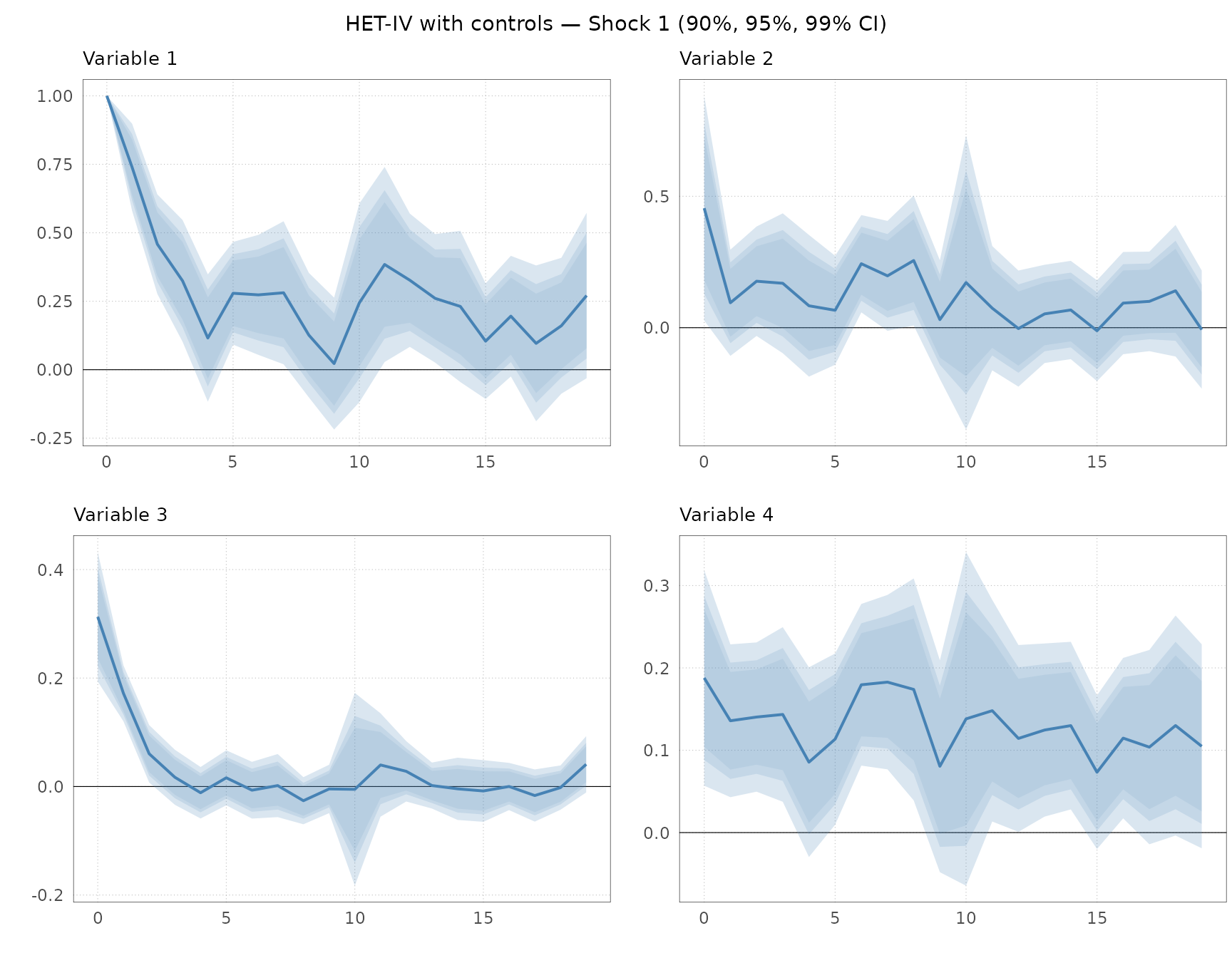
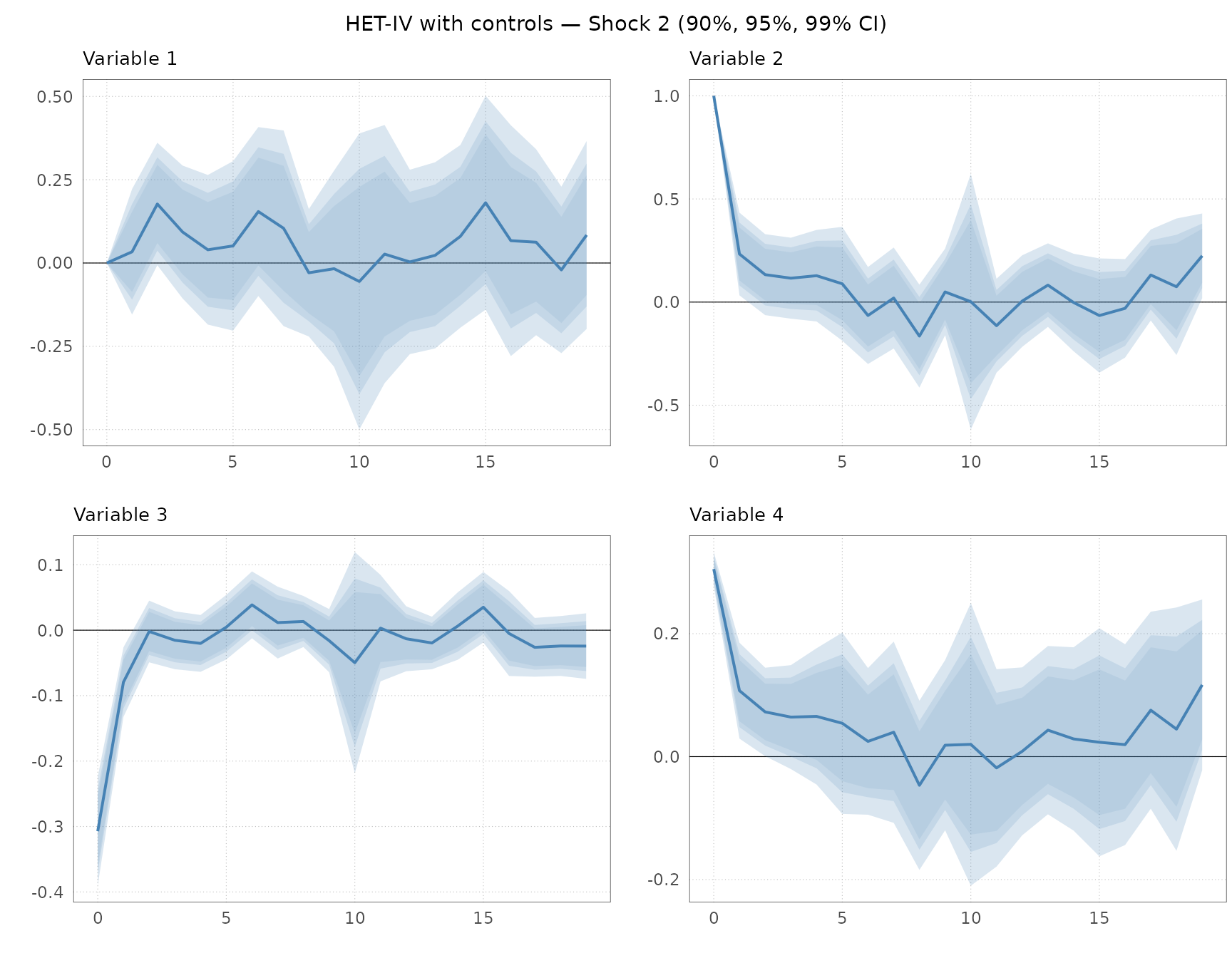
Impulse responses with confidence intervals
We can assess the accuracy of the estimates, and the dynamic causal
effects, using plotirf(). The function plots IRFs with
shaded confidence bands for up to three estimation approaches. For each
approach, the bands are computed from standard errors (normal bands) or
from bootstrap draws (percentile bands centred on the point estimate by
default; boot_type = "percentile" gives raw percentile
bands), or suppressed if neither is supplied. By default a single 90%
band is drawn; up to two confidence levels can be chosen. Here, we show
the 90% and 95% confidence intervals for the HET-IV estimates with
controls. plotirf() returns one panel per variable and
shock; arrangeirf() arranges them into one figure per
shock.
var_labels <- paste0("Variable ", 1:N)

plots_het_X <- plotirf(
  IRF    = res_het_X,
  HTick  = 5,
  Labels = var_labels,
  ci     = c(0.90, 0.95)
)

invisible(arrangeirf(
  plots_het_X, E = E, N = N, nRows = 2,
  title = paste0("HET-IV with controls — Shock ", seq_len(E), " (90%, 95% CI)")
))
HET-IV estimates versus true IRF
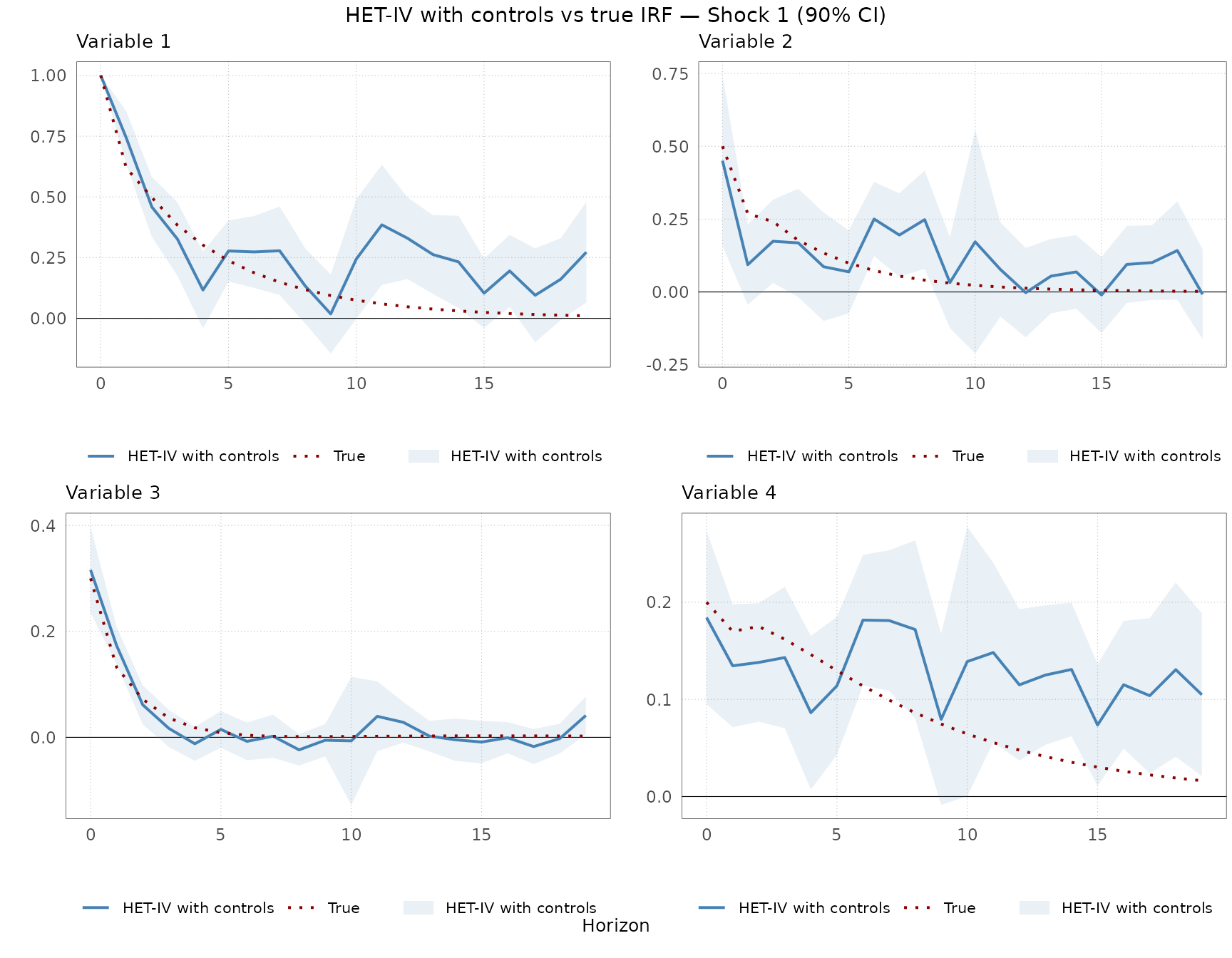
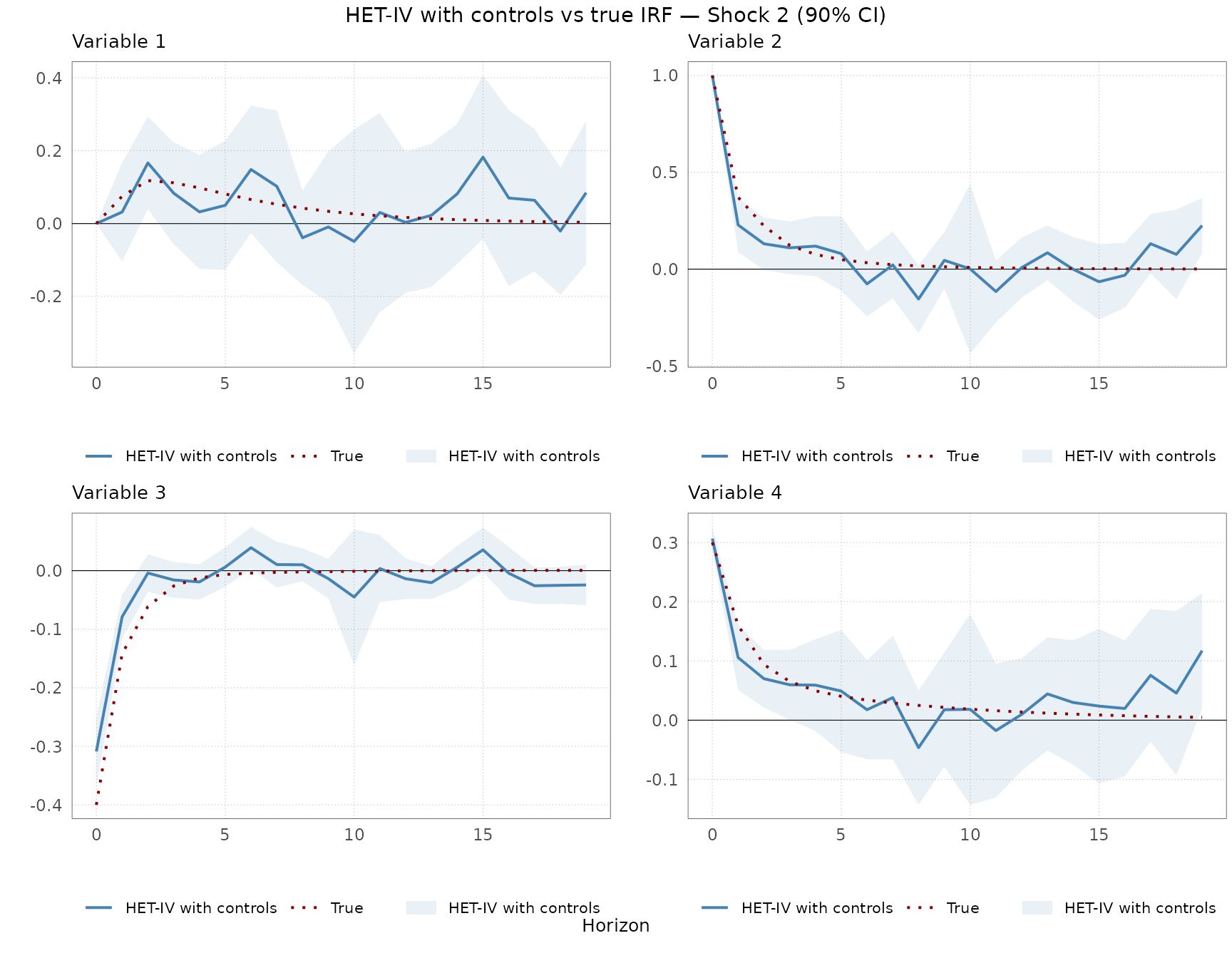
We can compare the estimates to the true impulse responses by passing
a list of IRFs to plotirf(). We compare the HET-IV estimate
(blue) against the theoretical IRF computed from the known VAR
parameters (red). The function computeirf() computes the
theoretical IRF. No standard errors are supplied for the true IRF, so no
confidence bands are plotted for it.
irf_true <- computeirf(PsiE, Phi, H, cum = FALSE)

plots_vs_true <- plotirf(
  IRF    = list(res_het_X, irf_true),
  HTick  = 5,
  Labels = var_labels,
  ci     = 0.90,
  names  = c("HET-IV with controls", "True"),
  legend = TRUE
)

invisible(arrangeirf(
  plots_vs_true, E = E, N = N, nRows = 2,
  title = paste0("HET-IV with controls vs true IRF — Shock ", seq_len(E), " (90% CI)")
))
HET-IV estimates versus misspecified model
We can also compare the accuracy of the estimates using the correct and misspecified models.
plots_vs_missp <- plotirf(
  IRF    = list(res_het_X, res_het),
  HTick  = 5,
  Labels = var_labels,
  ci     = 0.90,
  names  = c("With controls", "Without controls"),
  legend = TRUE
)

invisible(arrangeirf(
  plots_vs_missp, E = E, N = N, nRows = 2,
  title = paste0("HET-IV with vs without controls — Shock ", seq_len(E), " (90% CI)")
))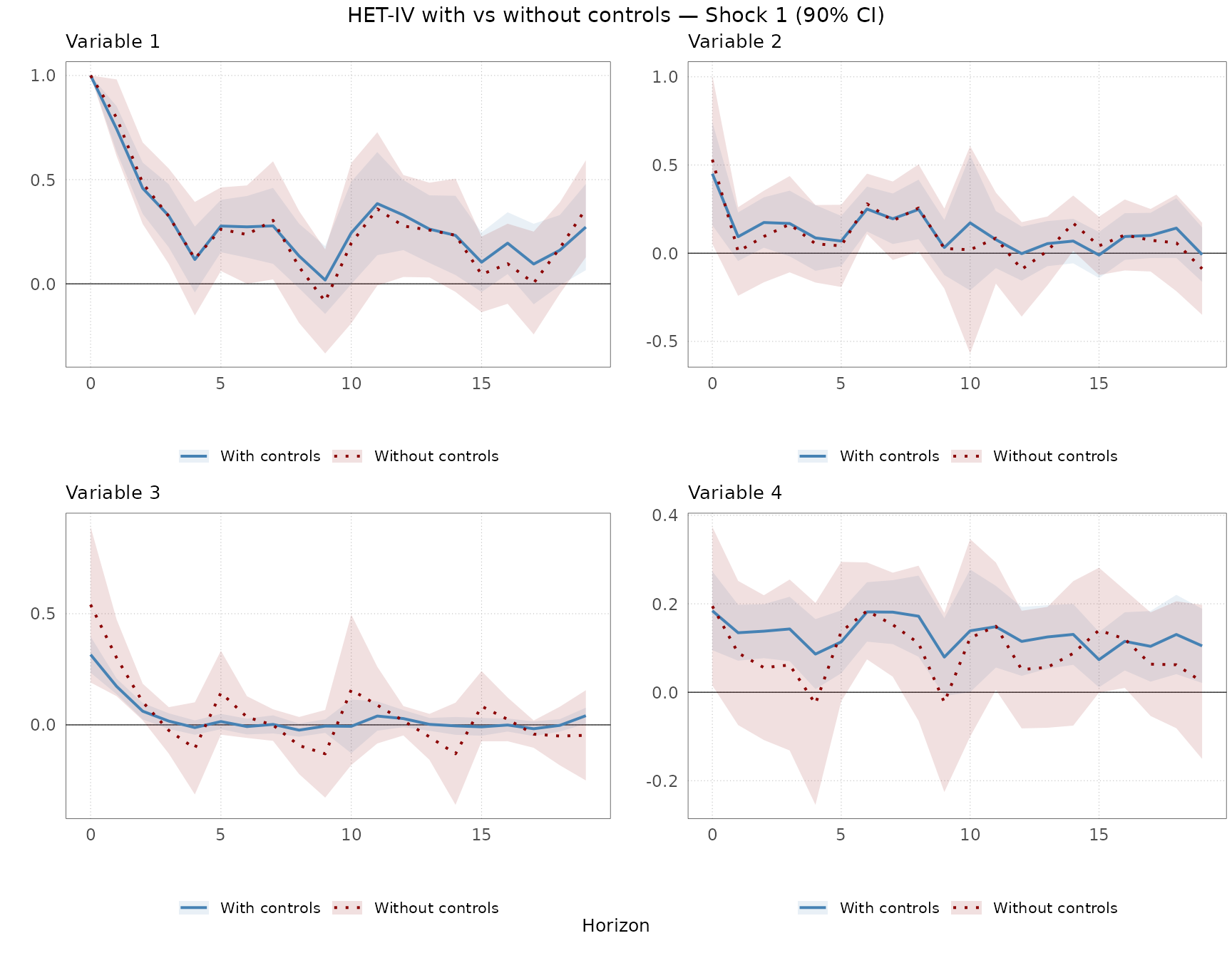
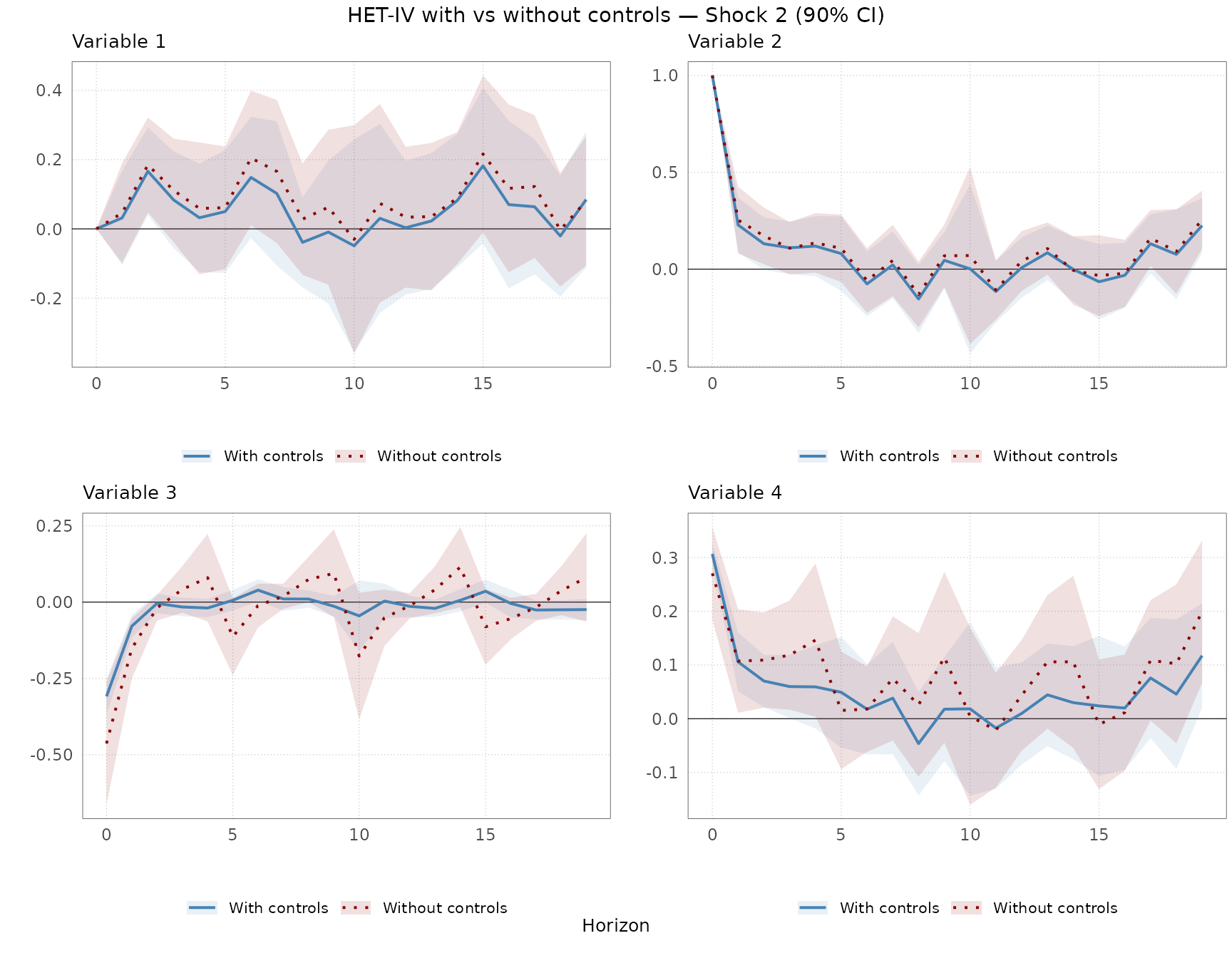
We see that the confidence intervals are wider using the misspecified model (red). This is especially true for the third and fourth variables that are affected by the deterministic weekday pattern. The misspecified model does not account for this pattern, which leads to more uncertainty and biased estimates. The intervals are also somewhat wider for variables 1 and 2 because we fail to control for lagged dependent variables.
HET-IV versus Proxy-IV
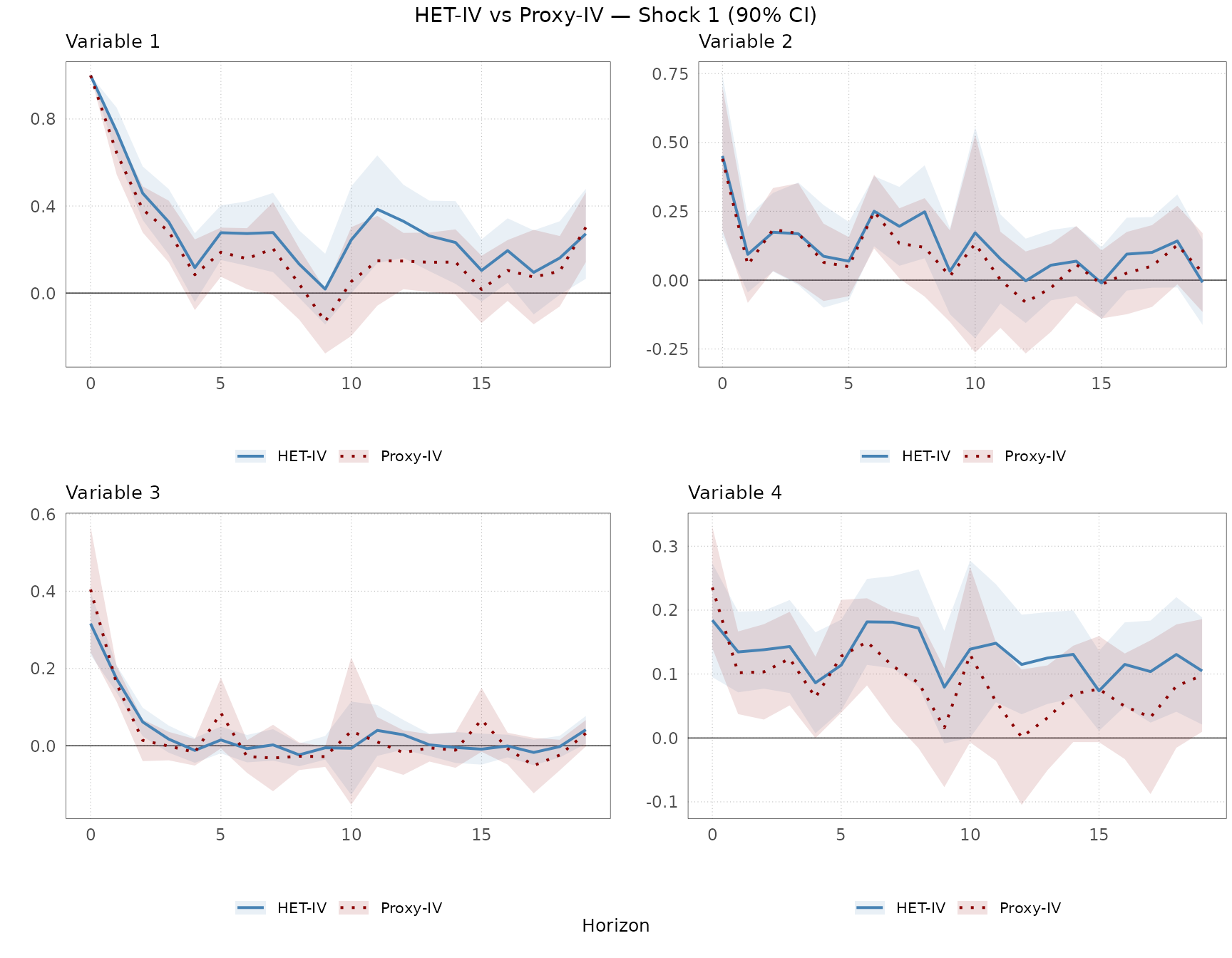
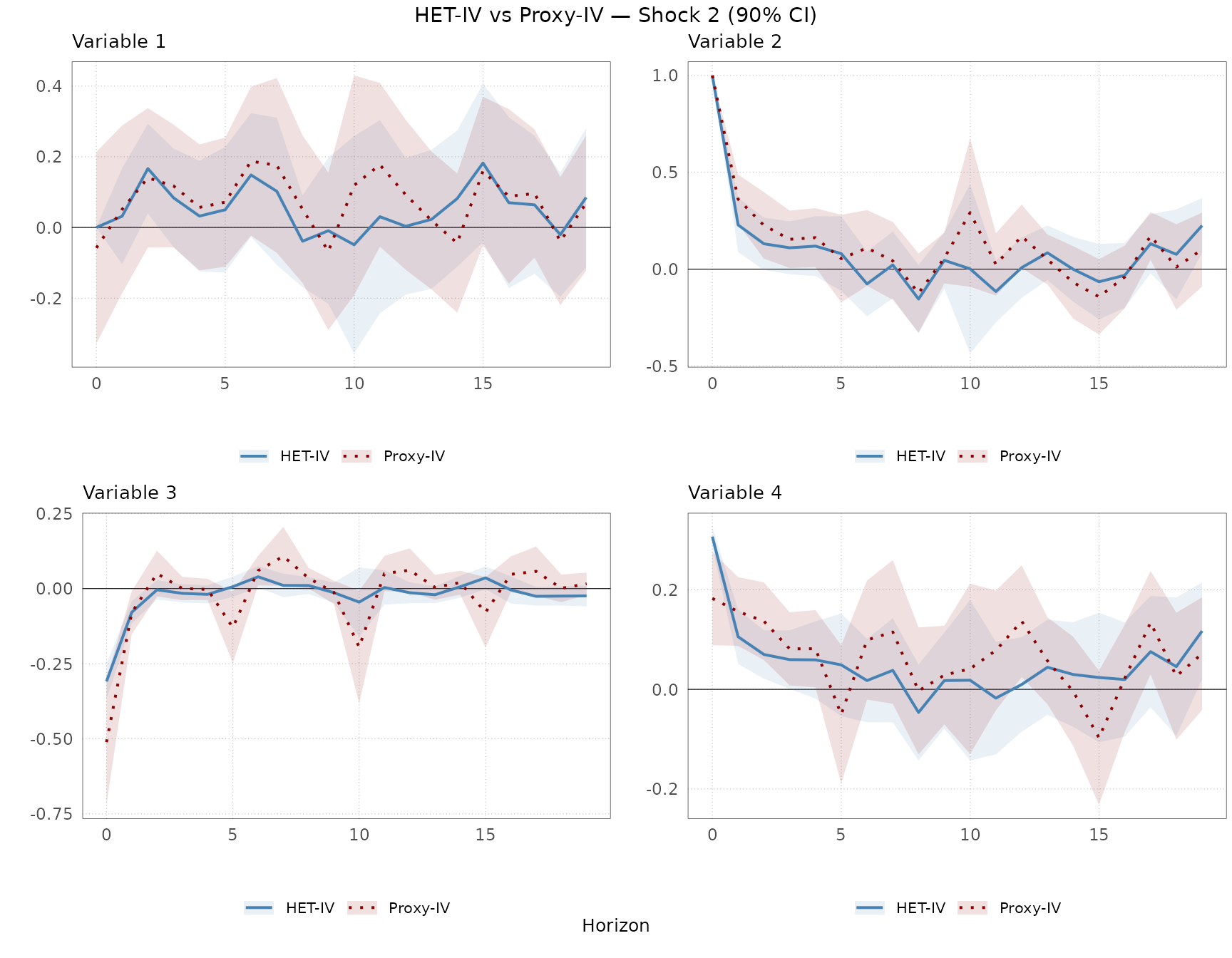
Next, we compare the HET-IV estimates to the Proxy-IV estimates. We obtain relatively similar point estimates across the two approaches.
plots_vs_proxy <- plotirf(
  IRF    = list(res_het_X, res_proxy),
  HTick  = 5,
  Labels = var_labels,
  ci     = 0.90,
  names  = c("HET-IV", "Proxy-IV"),
  legend = TRUE
)

invisible(arrangeirf(
  plots_vs_proxy, E = E, N = N, nRows = 2,
  title = paste0("HET-IV vs Proxy-IV — Shock ", seq_len(E), " (90% CI)")
))
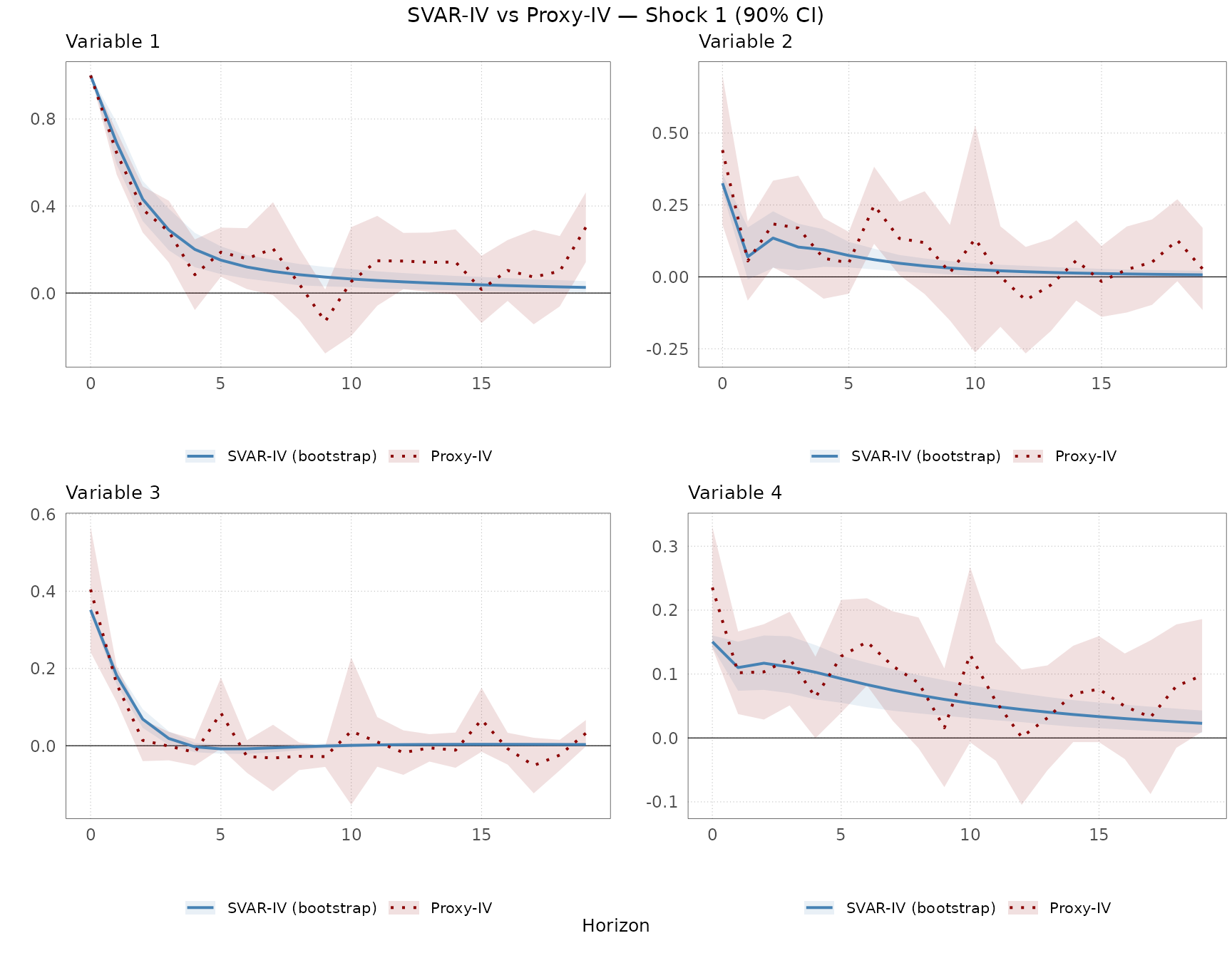
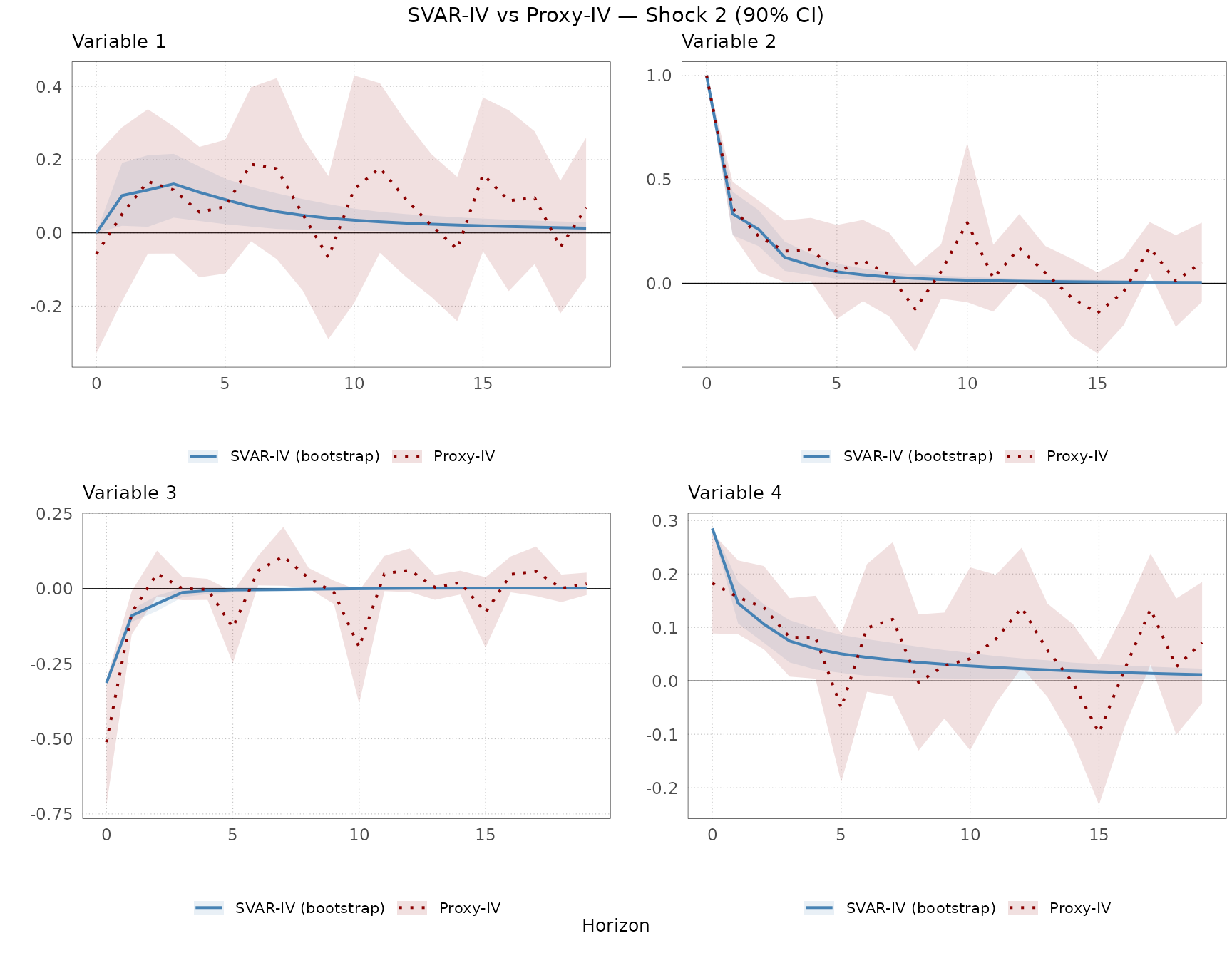
Proxy-SVAR with bootstrap bands
Finally, svariv() estimates a proxy SVAR (SVAR-IV)
following Mertens and Ravn (2013): a VAR with \(P\) lags is estimated by OLS on the full
sample, the impact matrix of the first \(E\) shocks is identified with the external
instruments on the sample where the proxies are observed, and the
impulse responses follow by recursion. With nboot > 0,
the function returns the bootstrap draws, from which
plotirf() computes percentile bands centred on the point
estimate (or raw percentile bands with
boot_type = "percentile"). We compare the SVAR-IV estimates
to the Proxy-IV local projections.
set.seed(42)
res_svar <- svariv(
  y     = y_data,
  Z     = e_proxy,
  X     = X_data,
  P     = P,
  H     = H,
  E     = E,
  norm  = 1,
  nboot = 200
)

plots_svar <- plotirf(
  IRF    = list(res_svar, res_proxy),
  HTick  = 5,
  Labels = var_labels,
  ci     = 0.90,
  names  = c("SVAR-IV (bootstrap)", "Proxy-IV"),
  legend = TRUE
)

invisible(arrangeirf(
  plots_svar, E = E, N = N, nRows = 2,
  title = paste0("SVAR-IV vs Proxy-IV — Shock ", seq_len(E), " (90% CI)")
))
Shock extraction
kfpredict() recovers structural shocks from reduced-form
residuals via a Kalman filter prediction. It requires the estimated
impact matrix Psi, the residual covariance matrices on
event and control days (Sig, SigR), and the
residuals et. With details = TRUE, the
estimators call kfpredict() automatically and return the
predicted shocks as Shocks. By default, the prediction is
based on the one-step-ahead residuals and the impact responses; the
option hpredict selects a longer horizon instead
(hpredict = 0 is the impact horizon, matching the row
labels of irf).
shocks_het <- res_het$Shocks
shocks_het_X <- res_het_X$Shocks
shocks_proxy <- res_proxy$Shocks
shocks_proxy_rec <- res_proxy_rec$Shocks

# The same prediction can be obtained by calling kfpredict() directly
all.equal(
  shocks_het_X,
  kfpredict(
    Sig = res_het_X$Sig, SigR = res_het_X$SigR,
    Psi = res_het_X$Psi, et = res_het_X$et
  )
)
#> [1] TRUE
We assess the accuracy of the predictions by comparing them to the true event shocks from the underlying model.
true_shocks <- sim$eE

cor_df1 <- data.frame(
  True = true_shocks[, 1],
  Proxy = e_proxy[, 1],
  HET_IV = shocks_het[, 1],
  HET_IV_X = shocks_het_X[, 1],
  Proxy_IV_X = shocks_proxy[, 1],
  Proxy_IV_Rec = shocks_proxy_rec[, 1]
)

cor_df2 <- data.frame(
  True = true_shocks[, 2],
  Proxy = e_proxy[, 2],
  HET_IV = shocks_het[, 2],
  HET_IV_X = shocks_het_X[, 2],
  Proxy_IV_X = shocks_proxy[, 2],
  Proxy_IV_Rec = shocks_proxy_rec[, 2]
)

tab_all <- data.frame(
  rbind(
    round(cor(cor_df1, use = "complete.obs"), 2)[1, ],
    round(cor(cor_df2, use = "complete.obs"), 2)[1, ]
  )
)
rownames(tab_all) <- c("Shock 1", "Shock 2")

knitr::kable(
  tab_all,
  col.names = c(
    "True", "Proxy", "HET-IV without controls", "HET-IV with controls",
    "Proxy-IV with controls", "Proxy-IV with recursive restriction"
  ),
  row.names = TRUE,
  caption = "Correlation of predicted shocks with true shocks"
)| True | Proxy | HET-IV without controls | HET-IV with controls | Proxy-IV with controls | Proxy-IV with recursive restriction | |
|---|---|---|---|---|---|---|
| Shock 1 | 1 | 0.91 | 0.68 | 1.00 | 0.79 | 0.79 |
| Shock 2 | 1 | 0.80 | 0.85 | 0.94 | 0.63 | 0.63 |
The correlation between the true shocks and the proxy is slightly lower than one due to an attenuation bias (see Burri and Kaufmann, 2026a), which depends on the variance of the noise term affecting the proxy. The correlation of the prediction is also relatively low if we use a misspecified model. However, if we use the correct model, the correlation is close to unity for Shock 1 and 0.94 for Shock 2. Proxy-IV with controls yields a high correlation as well, at least for Shock 1. Note that the specific values depend on the exact nature of the simulated data.
Prediction from several horizons
By default, the shocks are predicted from the one-step-ahead forecast
errors and the impact responses. The same projection applies to the
forecast errors of y_{t+h} given the information dated
t-1, with the impact responses replaced by the
horizon-h responses (hpredict = h), and to the
forecast errors of all horizons 0, ..., h jointly
(pooled = TRUE). The pooled prediction weights every
horizon by its signal-to-noise ratio and, in population, has a weakly
smaller mean squared error than the prediction from any single horizon.
If all responses are complete on impact, it coincides with the impact
prediction, and a single later horizon can only add noise.
The pooled prediction requires a nonsingular covariance of the
stacked forecast errors, which is estimated on event days only. A
sufficient condition is that at least as many non-policy shocks as
variables drive the data. The simulated model above violates this
condition deliberately: two regular shocks drive four variables, so the
twelve stacked forecast errors of horizons 0 to 2 are driven by only
eight shocks and their covariance is singular. kfpredict()
warns in this case and falls back on a generalised inverse, which makes
the prediction sensitive to estimation error in the responses. The table
shows the consequence: the pooled prediction is better than the single
horizon-2 prediction but clearly worse than the impact prediction.
res_het_h2 <- hetiv(
  y = y_data, O = y_data, X = X_data, Ind = Ind, P = P, H = H, E = E,
  norm = 1, hpredict = 2, details = TRUE
)
res_het_pool <- hetiv(
  y = y_data, O = y_data, X = X_data, Ind = Ind, P = P, H = H, E = E,
  norm = 1, hpredict = 2, pooled = TRUE, details = TRUE
)
#> Warning: Sig is (nearly) singular: the smallest eigenvalue of its correlation
#> matrix is 1.3e-05 relative to the largest. The generalized inverse regularizes
#> the prediction, which is sensitive to estimation error in Psi. For pooled
#> horizons, the stacked residual covariance is nonsingular only if at least as
#> many non-policy shocks as variables drive the data and the number of complete
#> event days exceeds the number of residual series.
dim(res_het_pool$Psi) # N(h+1) x E: responses at horizons 0, 1, 2 stacked
#> [1] 12  2

cor_pool <- function(true, r0, r2, rp, k) {
  c(
    Impact   = cor(true[, k], r0$Shocks[, k], use = "complete.obs"),
    Horizon2 = cor(true[, k], r2$Shocks[, k], use = "complete.obs"),
    Pooled   = cor(true[, k], rp$Shocks[, k], use = "complete.obs")
  )
}
tab_pool <- round(rbind(
  cor_pool(true_shocks, res_het_X, res_het_h2, res_het_pool, 1),
  cor_pool(true_shocks, res_het_X, res_het_h2, res_het_pool, 2)
), 2)
rownames(tab_pool) <- c("Shock 1", "Shock 2")
knitr::kable(
  tab_pool,
  col.names = c("Impact (hpredict = 0)", "Horizon 2 (hpredict = 2)", "Pooled (horizons 0-2)"),
  row.names = TRUE,
  caption = "Correlation of predicted shocks with true shocks by prediction horizon (two regular shocks, singular stacked covariance)"
)| Impact (hpredict = 0) | Horizon 2 (hpredict = 2) | Pooled (horizons 0-2) | |
|---|---|---|---|
| Shock 1 | 1.00 | 0.80 | 0.87 |
| Shock 2 | 0.94 | 0.57 | 0.71 |
With as many regular shocks as variables, the stacked covariance is nonsingular and the pooled prediction behaves as the theory predicts. We simulate a second data set that differs from the first only in two additional regular shocks. The impact prediction is less accurate than before, because the additional shocks add noise on impact, but the pooled prediction is now about as accurate as the impact prediction, while the single horizon-2 prediction remains clearly worse. The small remaining gap reflects the estimation of a 12 by 12 covariance from about 50 event days.
PsiR4 <- cbind(PsiR, c(0.1, 0.2, 1.0, -0.2), c(-0.1, 0.1, 0.3, 1.0))
sim4 <- simulatedata(
  Phi = Phi, SigE = SigE, PsiE = PsiE, PsiR = PsiR4,
  Nobs = Nobs, Nbin = Nbin, N = N, R = ncol(PsiR4), E = E,
  Nevn = Nevn, P = P, eDist = 0, seed = 42
)
y4 <- sim4$y
Ind4 <- as.integer(sim4$IndE[, 1])
fit4 <- function(...) {
  hetiv(y = y4, O = y4, Ind = Ind4, P = P, H = H, E = E, norm = 1, details = TRUE, ...)
}
res4_0 <- fit4()
res4_h2 <- fit4(hpredict = 2)
res4_pool <- fit4(hpredict = 2, pooled = TRUE)

tab_pool4 <- round(rbind(
  cor_pool(sim4$eE, res4_0, res4_h2, res4_pool, 1),
  cor_pool(sim4$eE, res4_0, res4_h2, res4_pool, 2)
), 2)
rownames(tab_pool4) <- c("Shock 1", "Shock 2")
knitr::kable(
  tab_pool4,
  col.names = c("Impact (hpredict = 0)", "Horizon 2 (hpredict = 2)", "Pooled (horizons 0-2)"),
  row.names = TRUE,
  caption = "Correlation of predicted shocks with true shocks by prediction horizon (four regular shocks, nonsingular stacked covariance)"
)| Impact (hpredict = 0) | Horizon 2 (hpredict = 2) | Pooled (horizons 0-2) | |
|---|---|---|---|
| Shock 1 | 0.91 | 0.71 | 0.88 |
| Shock 2 | 0.91 | 0.49 | 0.88 |
The pooled prediction is therefore most useful when the responses build up after the event, so that later horizons carry information that the impact response misses, and when the number of event days is large relative to the dimension of the stacked covariance.
Weak instrument test
gweakivtest() implements the generalised minimum
eigenvalue test of Lewis and Mertens (2025), which is robust to
heteroskedasticity and autocorrelation and applicable to multiple
endogenous regressors and multiple instruments. Note that classical
Stock-Yogo (2005) test is applicable only for the homoskedastic
case.
With details = TRUE, hetiv() and
proxyiv() run the weak instrument tests automatically on
the sample of every local projection. For a single shock
(E = 1), the data frame FirstStage reports, by
horizon, the homoskedastic first-stage F statistic (the squared t
statistic of the instrument; Stock and Yogo, 2005) and the robust
effective F statistic of Montiel Olea and Pflueger (2013), always
computed with the HAC (Newey West) covariance estimator, irrespective of
the cov_type used for the standard errors. When the proxy
is set to zero on control days, the robust statistic should be
preferred: the homoskedastic F treats the many zero observations as
informative and overstates the strength of the instrument.
svariv() reports the same two statistics with
details = TRUE, using HC0 by default. For several shocks
(E > 1), as in this example, the data frame
WeakTest reports the generalised minimum eigenvalue
statistic together with its critical values for every shock dimension
(target), horizon h and outcome variable
i. For shock dimension e, the test is applied
to the system with the first e policy variables as
endogenous regressors and the first e instruments, and
targets the coefficient on policy variable e. The statistic
depends on the horizon only through the estimation sample, whereas the
critical values may differ across outcomes and horizons. The test always
uses the HAR (Newey West) covariance estimator, irrespective of
cov_type, and the relative bias criterion, which makes the
critical values comparable with those of Montiel Olea and Pflueger
(2013). The test uses a bias tolerance of 10% at a significance level of
5%. The estimators also return a WeakData data frame with
the variables expected by gweakivtest() for custom
tests.
The table below shows the test on impact (h = 0) for the
third variable for each shock and each of the four specifications.
specs <- list(
  "HET-IV, no controls" = res_het$WeakTest,
  "HET-IV, with controls" = res_het_X$WeakTest,
  "Proxy-IV, with controls" = res_proxy$WeakTest,
  "Proxy-IV, with controls + recursive restriction" = res_proxy_rec$WeakTest
)

tab <- do.call(rbind, lapply(names(specs), function(nm) {
  r <- specs[[nm]][specs[[nm]]$h == 0 & specs[[nm]]$i == 3, ]
  data.frame(
    Specification = nm,
    Shock = r$target,
    Statistic = round(r$gmin, 2),
    LM_CV = round(r$cv, 2),
    Strong = ifelse(r$gmin > r$cv, "Yes", "No"),
    stringsAsFactors = FALSE
  )
}))

knitr::kable(
  tab,
  col.names = c(
    "Specification", "Shock", "Statistic", "LM critical value",
    "Strong instruments?"
  ),
  caption = "Weak instrument test results on impact (Lewis-Mertens generalised minimum eigenvalue test)"
)| Specification | Shock | Statistic | LM critical value | Strong instruments? |
|---|---|---|---|---|
| HET-IV, no controls | 1 | 47.13 | 14.19 | Yes |
| HET-IV, no controls | 2 | 24.51 | 25.04 | No |
| HET-IV, with controls | 1 | 727.88 | 14.19 | Yes |
| HET-IV, with controls | 2 | 137.26 | 23.45 | Yes |
| Proxy-IV, with controls | 1 | 150.41 | 14.19 | Yes |
| Proxy-IV, with controls | 2 | 22.45 | 22.63 | No |
| Proxy-IV, with controls + recursive restriction | 1 | 150.41 | 14.19 | Yes |
| Proxy-IV, with controls + recursive restriction | 2 | 22.45 | 22.63 | No |
All specifications pass the test for the first shock by a wide
margin. For the second shock, the specification without controls is
affected by a weak instrument problem, whereas the correctly specified
model passes the test. Proxy-IV is borderline for the second shock: the
statistic lies just below the critical value. Note that this depends on
the degree of noise used to construct the proxy and does not suggest
that hetiv() is generally superior to
proxyiv(). The recursive restriction does not change the
test, because the test does not depend on the recursive controls: the
system for shock e always contains the first e
policy variables and instruments. In this example, the critical values
are around 14 for the first shock (one endogenous regressor) and around
23 for the second shock (two endogenous regressors). The latter is close
to the conservative critical value of the simplified HAR test for the
univariate case by Montiel Olea and Pflueger (2013) and Lewis (2022).
Both are higher than the common rule of thumb of 10 for the Stock and
Yogo (2005) test.
Because the critical values may depend on the outcome variable and
the horizon, it is useful to inspect the full WeakTest data
frame. The following table shows, for HET-IV with controls and the
second shock, the statistic and the critical value for the third and
fourth variables at selected horizons.
wt <- res_het_X$WeakTest
wt <- wt[wt$target == 2 & wt$i %in% c(3, 4) & wt$h %in% c(0, 5, 10, 19), ]
wt$Strong <- ifelse(wt$gmin > wt$cv, "Yes", "No")

knitr::kable(
  wt[, c("h", "i", "Tobs", "gmin", "cv", "Strong")],
  digits = 2, row.names = FALSE,
  col.names = c("Horizon", "Variable", "Obs.", "Statistic", "LM critical value", "Strong instruments?"),
  caption = "Weak instrument test by horizon and outcome variable (HET-IV with controls, second shock)"
)| Horizon | Variable | Obs. | Statistic | LM critical value | Strong instruments? |
|---|---|---|---|---|---|
| 0 | 3 | 498 | 137.26 | 23.45 | Yes |
| 5 | 3 | 493 | 140.97 | 23.63 | Yes |
| 10 | 3 | 488 | 140.92 | 23.64 | Yes |
| 19 | 3 | 479 | 143.17 | 23.51 | Yes |
| 0 | 4 | 498 | 137.26 | 23.59 | Yes |
| 5 | 4 | 493 | 140.97 | 23.42 | Yes |
| 10 | 4 | 488 | 140.92 | 23.47 | Yes |
| 19 | 4 | 479 | 143.17 | 23.51 | Yes |
References
Burri, M. and Kaufmann, D. (2026a). Measuring monetary policy shocks. IRENE Working Papers 24-03, IRENE Institute of Economic Research, University of Neuchâtel.
Burri, M. and Kaufmann, D. (2026b). Multiple monetary policy shocks from daily data: A heteroskedasticity IV approach. Economics Letters, 268, 113091. https://doi.org/10.1016/j.econlet.2026.113091
Gertler, M. and Karadi, P. (2015). Monetary policy surprises, credit costs, and economic activity. American Economic Journal: Macroeconomics, 7(1), 44–76.
Jordà, Ò. (2005). Estimation and inference of impulse responses by local projections. American Economic Review, 95(1), 161–182.
Lewis, D. J. (2022). Robust inference in models identified via heteroskedasticity. Review of Economics and Statistics, 104(3), 510–524.
Lewis, D. J. and Mertens, K. (2025). A robust test for weak instruments for 2SLS with multiple endogenous regressors. Review of Economic Studies, DOI: 10.1093/restud/rdaf103.
Mertens, K. and Ravn, M. O. (2013). The dynamic effects of personal and corporate income tax changes in the United States. American Economic Review, 103(4), 1212–1247.
Montiel Olea, J. L. and Pflueger, C. E. (2013). A robust test for weak instruments. Journal of Business & Economic Statistics, 31(3), 358-369.
Montiel Olea, J. L., M. Plagborg-Møller, E. Qian, C. K. Wolf (2025). Local projections or VARs? A primer for macroeconomists. NBER Macroeconomics Annual 2025, vol. 40, pp. 1-64, National Bureau of Economic Research.
Nakamura, E. and Steinsson, J. (2018). High-frequency identification of monetary non-neutrality: The information effect. Quarterly Journal of Economics, 133(3), 1283–1330.
Rigobon, R. (2003). Identification through heteroskedasticity. Review of Economics and Statistics, 85(4), 777–792.
Stock, J. H. and Watson, M. W. (2018). Identification and estimation of dynamic causal effects in macroeconomics using external instruments. Economic Journal, 128(610), 917–948.
Stock, J. H. and Yogo, M. (2005). Testing for weak instruments in linear IV regression. In D. W. K. Andrews and J. H. Stock (Eds.), Identification and inference for econometric models, pp. 80–108. Cambridge University Press.